Pages

Monday, October 24, 2011

Animalia, or Have you ever seen a baby elephant dance?

"The most dangerous thing in the bush is a female elephant. Male elephants like this one might mock charge you, but female elephants, when they charge, they don't play around."
- Our survival guide, Paul 

My last post was a bit of a downer, so I thought I'd lighten the mood with a happy topic: animals! I saw tons of animals this summer. I even got to play with some of them.* First, let me just clear up some potential misconceptions about where I was living: Johannesburg is a city. There weren't hippos crossing the roads or elephants wandering around. You'd have a better chance seeing wild animals in Chicago than in Jozy. That said, South Africa has enormous game reserves filled to the brim with animals. One we visited, Kruger National Park, has so many elephants they've had to cull them to keep them from destroying the environment.

Johannesburg Zoo

It might seem strange to go to a zoo in a city where, if you drive for two hours in any direction, you can see the same animals in the wild. However, with little to do on a Sunday morning and the zoo near our hostel, my classmates and I decided to give it a try. It was a pretty good trip. I don’t know whether it's due to lax safety standards or because the people have a better knowledge and respect for animals, but for some reason the enclosures were not particularly... well-enclosed. For instance, a small hedge separated us from the buffalo and we were close enough to feed the giraffes (and feed them we did). I miiiiight have touched both a monkey and a hog. Even more surprising was the fact that we were the only ones to shirk the rules. Kids and adults alike stepped back from the animals, didn’t tap on the glass or call to them, and certainly did not throw things into their habitats (rather unlike South Korea and China). 

The tiny wall that separated us from the giraffe we fed. I mean pet. I mean saw.


The lions had a good time too.

So jealous.


Lion Park

A bit of a tourist attraction, yes, but the lion park is no less awesome because of it. This is exactly as it sounds, a park filled with lions. You can play with the cubbies and pet and feed giraffes too. It's sort of like a petting zoo, except instead of goats and llamas you get to pet animals that can take down a buffalo with one swipe.


Vicious I tell you, vicious.

There were ostriches there too.


Safari

I had the opportunity to go on two safaris, one in the Pilanesberg Game Reserve and the other in Kruger National Park. My friends and I just did a drive through Pilanesberg, but we camped out in Kruger for one week. The campsites are surrounded by fences to keep out the most ferocious of the animals, but baboons and vervet monkeys find their way in. 

Night were spectacular - I saw the Milky Way and counted more stars than I'd ever seen before. Since we were in the Southern Hemisphere, I was confronted with a strange set of constellations I did not recognize. Other than the Southern Cross, which can apparently tell you the direction of due South at any time, I didn't really learn any of them.** At night, we could hear hyenas cackling from just outside the campsite.


One of the entrances to Kruger


Two male lions on the hunt


These zebras ran alongside our car for a few minutes.

The glossy starling, my favorite Southern African bird


Bathroom and shower facilities at one of the campsites we stayed at. We slept in tents.

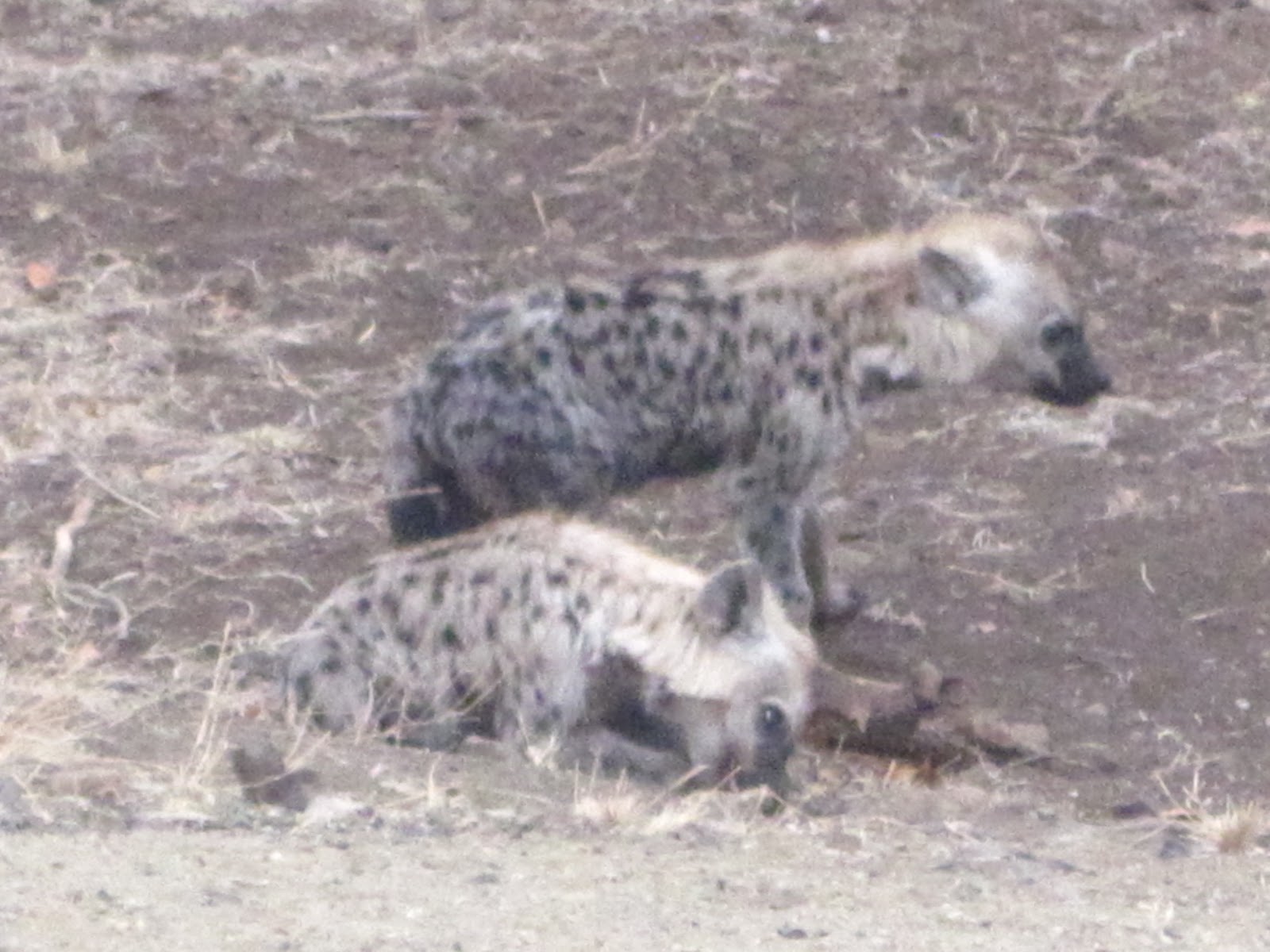
Hyena: our guide told us that lions and hyenas are such vicious rivals that a lion will sometimes break a hyena's spine and then just leave it there to starve to death

Hyena cubs

Lady giraffes


An interestingly-colored bull giraffe

Impala

White, or wide-lipped, rhino
There are two rhino species at Kruger, the white or wide-lipped rhino, and the black or hook-lipped rhino. The black rhino is very rare and much coveted for its horn. Unfortunately, while we were there we saw a poached black rhino carcass. Rhino horns are more valuable than gold because they are thought to be good for, er, male virility in some Asian countries.


Baboons

Monkeys gave us serious trouble on our campsite. Not only did they break into our car,  steal an entire loaf of bread, and attempt to eat my cards, they may have even stolen my classmate's t-shirt.

Kudu***

Old buffalo

When you're in game reserves like Pilanesberg and Kruger, you have to stay inside your car at all times. However, you can sign up for a bushwalk (at a ridiculously early time in the morning, like 5 or something) where you walk around with two guides carrying rifles. Mostly, we examined dung, but we also came across a few cool things.

Dead buffalo, with our two bushwalk guides

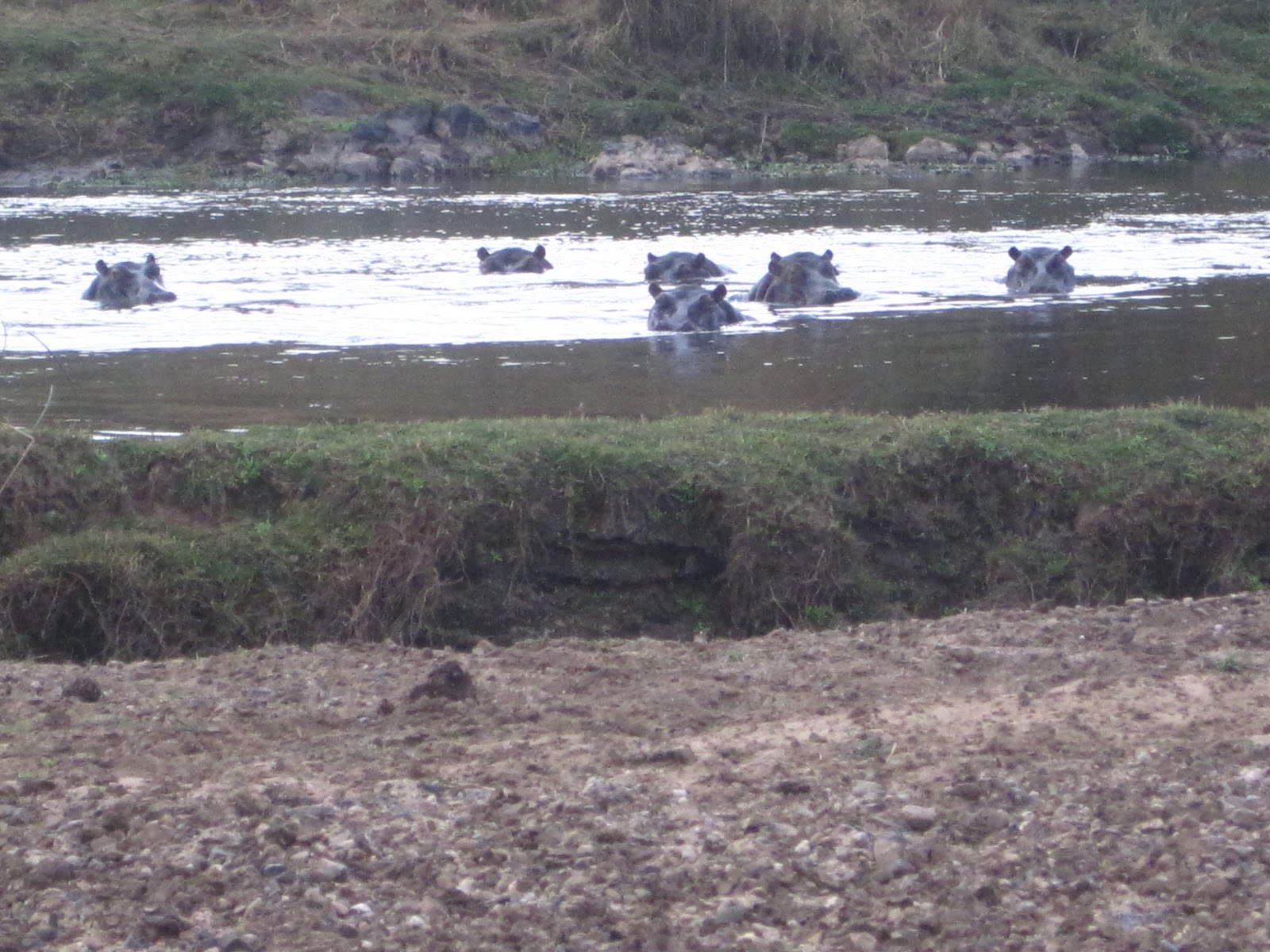
Hippos checking us out on the bushwalk; one eventually charged us and we had to run

I think he said his name was Livingstone

Probably the most exciting I saw on the entire safari - an impala carcass freshly abandoned by a leopard

Wildebeest

Elephant

Tiny little baby elephant


All right, here it is: a cute little baby elephant showing off its swing moves:


*Unfortunately, the pictures of me playing with lion cubs belong to someone else. 
** I did make a couple up though. If you're ever in the Southern Hemisphere, look for the "Spitting Cobra."
*** Also the mascot of the college I worked at:
 

Thursday, October 13, 2011

Soweto

D, the same coworker who invited me to the poetry reading, also offered to take the interns on a guided tour through Soweto. We had all been very excited to visit the center of the apartheid resistance and gladly took her up on her offer, especially since she had grown up there.


Soweto (South Western Townships) is a township on the outskirts of Johannesburg. During apartheid, Black South Africans were forbidden from living in the city without permits, but their menial labor was vital to the day-to-day function of the city so they were kept in townships nearby.* Because the people living in the townships were poor, disease and crime were very common. Many people lived in government-built RDP houses, which are two-room structures (without bathrooms). RDP houses are still commonly found there, but many residents have added to their residences with additional structures. We had the opportunity to go inside one of them and while it was small, it did not feel so different from the inside of many American homes.


D first took us to see the Regina Mundi church, which was one of the centers of the anti-apartheid movement. Because political meetings were banned, activists used the church as a meeting place. Famed for the bullet holes sustained during the Soweto Uprising, the Reverend Jesse Jackson, the Clintons, and more recently Michelle Obama have given inspired speeches there.


The Soweto Uprising of 1976 began in response to a law declaring Afrikaans the language of instruction in all schools. Afrikaans (a Dutch-related language) was affiliated with the apartheid government, and was thus unpopular amongst the nation's Black population. D's friend from school told us what it was like after this law was passed. He said that one day he was learning chemistry in English, the next, without any Afrikaans instruction, his lesson was in Afrikaans. (Chemistry is hard enough, I thought.) Because it affected schoolchildren, the rally was organized and orchestrated by students. The plan was to march down the main street in Soweto until they arrived at Orlando Stadium. They didn't make it very far. Police soon set dogs on the children, and before long began shooting at them. Hundreds of people died.** The most famous victim was a 12-year old boy named Hector Pieterson, whose lifeless body was photographed and shown around the world.

We visited the Hector Pieterson Museum and Memorial,*** which provided a lot of interesting information about the education system in the townships and how the students were able to organize during that time. We also got a personal account from D, who had been a teenager during the Soweto Uprising, and had participated in it herself. She showed us something pretty special at the museum:

15-year old D participating in the rally.


Nelson Mandela and Desmond Tutu once lived on the same street in Soweto. That street is now a bit of a tourist attraction.


We ended the night with a trip to Soweto's first restaurant, Wandie's. Now also a major tourist attraction, Wandie's features the closest thing to real South African cuisine we found: samp and beans, an assortment of curries, and rice. Though a little pricey, it was delicious. The walls of the restaurant are covered in currencies from around the world so we added a dollar bill and wrote down our names and places of origin.


*For a (from what I've been told) accurate representation of an apartheid-era township, see the movie District 9, which was filmed in Soweto.
**Both White and Black.
***While I later visited the Apartheid Museum, which gives a much more in-depth perspective of apartheid, the images of this museum remain the most imprinted in my memory.

Thursday, October 6, 2011

Jozy

My coworker, D, invited me to a poetry reading in Newtown one evening. Newtown is located in downtown Johannesburg and is part of the inner city revitalization project. Many of the city's poorest live downtown and condemned buildings are a common sight. Newtown, however, now has a hip, artsy vibe to it, with museums, cafes, restaurants, a theater, and bookstores. The city's young, educated crowd can be found congregating there discussing art and poetry over wine (the poetry reading I attended had free wine and snacks). It was a great experience for me because it was neither a tourist attraction (lion cubs) nor something I could see back home (highways). The headlining poet was from Jamaica, but the opening acts were all young South Africans. Their poetry maneuvered effortlessly between  languages, cultures, and slangs. One second it was in English, the next in Zulu. One moment I could understand what they were saying, then the next thing I knew the crowd was laughing at some phrase I didn't understand. It was a fascinating experience, and one which was reinforced throughout my time in South Africa.

"Jozy's cabs will never be like Durb's" said one of the young poets. My coworker saw my blank look and turned to me: "Jozy is Johannesburg and Durbs is Durban." "Jozy's cabs will never be like Durb's" he repeated. "Jozy's cabs will never be like Durb's" he said yet again, this time miming something with his hands. The crowd hooted and whistled.

***

I found myself in Newtown a few weeks later for a modern art exhibit in a converted factory. It was a lot like how I imagine Greenwich Village; Hipsters abounded as I'd never seen before. There were vintage clothes and posters for sale, and stalls selling weird organic/alternative/funky food. I decided to try out the hot dog stand, which had some unique condiments: tomato and onion chutney, peanut and sweet chili sauce, and smashed Fritos (which they pronounced "fry-toes"). Since they allowed you to choose as many condiments as you wanted, I went with the latter two. While the peanut and sweet chili sauce wasn't bad, the crunch of the smashed Fritos sort of made my hot dog taste gritty. My opinions weren't shared by everyone, however: I overheard another patron dubbing the hot dog toppings "epic."

My fellow interns and I had been invited to the art exhibit by a girl who had come by our office one day looking for a job. She'd just graduated from college in the US and had studied abroad in Johannesburg, so she came back looking to do some women's rights work (though her South African boyfriend might have had something to do with it). There were also two undergrads from Harvard who were working at the Special Olympics and teaching people basketball (apparently it's not very popular in SA). Meeting these young people made me realize how boring I'd been at their age.* I had always considered myself quite adventurous for studying abroad in Europe and teaching in Korea, but going all the way to South Africa was so much more interesting. After the art exhibit, we went to a karaoke bar in Greenside, a wealthy suburb of the city. This particular bar has a famous drink called the John Deere, which is a 2-liter bottle cut in half and filled with a mix of cane (like rum) and cream soda. I assume the beverage was the reason why everyone was singing terrible pop songs from the 80s.

*I was their age 2 years ago.

Wednesday, September 7, 2011

First Thing's First: Food

The most important thing I do when I'm in a new country is sample the foodstuffs. Most of what I ate in South Africa was similar to what I would eat in the US - a lot of pizza, hamburgers, chicken burgers, pasta, and other commonly eaten comestibles here. However, South Africa actually has a true mix of foods from all over the world.


Britain: The food is very heavily influenced by the fact that it is a former British colony. As such, fish and chips (what we would call french fries) is a common dish in restaurants. One of the tastiest things sold on campus* was called "chips chili," which was french fries covered in seasoned salt and then drenched in a delicious chili sauce. The closest thing I've had to the chili sauce stateside is Taco Bell hot sauce. Other British food staples, like Weetabix, Cadbury's chocolate, and savory pies (like Shepherd's pie) were sold in stores everywhere. If that weren't enough, the best way to tell that the country was once ruled by the British was the fact that the financially-strapped NGO where I worked always had tea in the cafeteria, if not electricity.


India: Relatedly, Indian food is also very common. Indian people were brought over by the British as indentured laborers or as migrants, I can only assume for the food. The most frequented restaurant at the campus food court was an Indian restaurant (though this might have something to do with the fact that nothing sold there was over $1). The best samosas (called "samoosas") I've ever eaten were sold at the World of Samoosas in Jo-burg.


Dutch: The Dutch and British fought two horrific wars dubbed the "Anglo-Boer wars" ("boer" means "farmer" in Dutch). Though the British won the wars, and the colony, it was the Dutch who eventually took over the country. Dubbing themselves "Afrikaaners" it was this government, and the language they called "Afrikaans," that is affiliated with the system of apartheid. Despite this less-than-savory reputation, the food of the Afrikaaners remains popular among all South Africans. A "braai," or barbecue, is a South African summer must-do and usually features boerwors (or "farmer sausage"). They also eat biltong ("rump tongue" mmmm), or what we would call jerky. Biltong is often used as a garnish in salads and on bread.

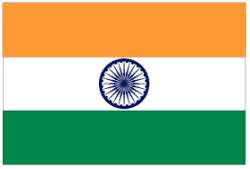
Does this flag look similar to anyone?**

Indonesia: The Dutch, who at some point ruled both South Africa and Indonesia, brought Indonesian slaves to the country. The mixing that occurred created the term "Cape Malay." Most Cape Malay people today live in the Western Cape, where Cape Town is located. As all great immigrant groups do, they created a delicious style of food. The quintessential Cape Malay dish is mutton curry.


South Africa/Africa: Of course, there are also foods native to the area. Two staple foods are samp, a corn-based food served with beans, and pap, a corn-based porridgey food. When I ate at a restaurant in Soweto,*** I had samp with my mutton curry. Another SA food, and possibly the most awesomely fun food item to pronounce is chakalaka, a sort of spicy tomato pickle eaten with samp, curries, and even as a condiment on boerwors.

*I worked on-campus at a large university.
**See Monaco.
***Lots more on Soweto later. For now, it was the largest township in South Africa during apartheid.

Chicago --> London --> Johannesburg

So I know I said that I was going to do this thematically rather than chronologically, but I changed my mind, at least for this first post. Sorry.

The morning of June 15, I finished moving out of my old apartment and put all of my worldly possessions in my new apartment a few blocks north. My new roommate helped me stash my stuff and then I rushed off to the airport.* I bought a few souvenirs for the family at the airport and met up with one of the two classmates going with me to South Africa.

10 hours later, at around 6AM, we arrived in London. Since our connecting flight was not until 7PM, I was planning to hang out in the city for a bit. However, the Director of the Intern Programme at my work happened to be in London at the same time and wanted to meet up with us that morning. My aunt drove to pick us up and unexpectedly picked up two parking tickets while waiting for us in what turned out to be the taxi lane. We headed straight to the Institute of Directors, where our new boss was awaiting us for tea.

The Institute of Directors, from http://venues.mcdonaldbutler.co/institute-of-directors
After a 30-minute-turned-3-hour-long meeting, I quickly met with my extended family and then hurried back to the airport.

My extended family was happy to see me.

A rather luxurious South African Airways flight later and I arrived in Jo-burg. We didn't technically have anywhere to live until July 1, so we'd booked a hotel for the first few days. Unfortunately, we also had a writing assignment to finish so I could not relax just yet.

*Well, "rushed off" might be a bit euphemistic. Originally, I had booked a shuttle to the airport, but when it was 30 minutes late I checked my ticket and saw that I'd booked it for the wrong day. I ended up shelling out $60 for a taxi instead.

Wednesday, August 24, 2011

I'm baaaaack

I returned safely from South Africa on Sunday morning. Since I didn't blog about anything all summer, I'll have plenty to catch up on, starting with why I didn't blog all summer and hopefully ending with thieving (though unsuccessful) monkeys. I'm a little busy at the mo' but I plan to get started soon. Instead of a chronological account like I did with my adventures in the East, I think I'll write thematically for my adventures in the South.*


*Did you know they have different constellations in the Southern hemisphere? Craaaazy!